UPDATE: I created a video example that shows real-time implementation.
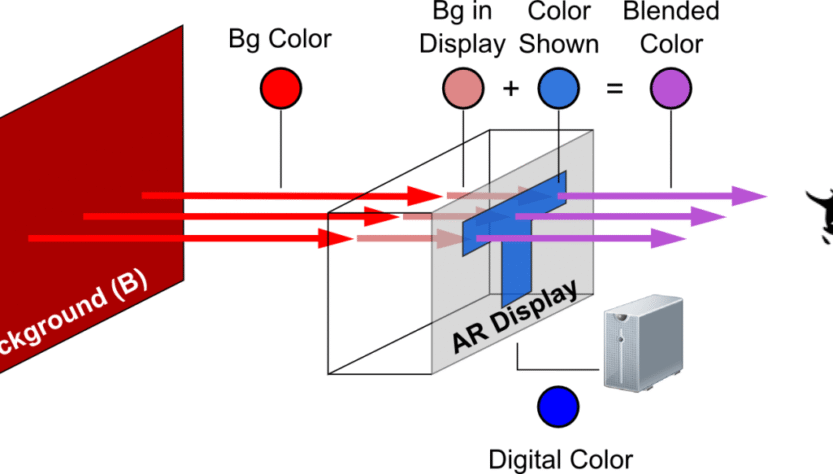
Last year we published a paper at the conference of the Virtual Reality Software and Technology (VRST ’13) on the subject of color correction for transparent displays. The paper suggests a solution for the color mixture, namely the phenomenon, in which colors look “washed out” in transparent displays. Ie the perceived color is a combination of display and background colors. Our solution is referred to as “color correction”, and the paper shows it in a very technical way, since it is necessary to describe a new understanding of the mixing problem and create a number of the exact color correction. Please check our paper here:
Srikanth Kirshnamachari Sridharan, Juan David Hincapié-Ramos, David R. Flatla and Pourang Irani. 2013. Color correction for optical search ads using display -color profiles. InProcedure of the 19th ACM symposium on software and technology on virtual reality (VRST ’13). ACM, New York, NY, USA, 231-240.
Color correction is very important for HMDs, since the color mixture influences the usability of such devices, especially outdoors. Always after the time of the field studies of HMDS show that users find it difficult to access the display content in order to search for dark stains or to cover the lens by hand (not so well for AR;)). With an upcoming wave of HMDs for the consumer market such as Meta, atheer One, Moverio BT-200 and ORA-S, the color correction will certainly receive a lot of attention. Our results for a projection display (Epson 3700 on Lumisty Film) show that the color correction has generated 36% more precise colors. Similar results can be achieved for HMDs. This is an essential result because platform or application developers can receive better colors without hardware changes.
One thing that I absolutely wanted to include in the paper, but the room has more, is examples of how good graphics can be corrected after corrected color corrected, and I plan to do that in this post. The following two images are corrected in different backgrounds (the accuracy of these samples is confirmed in section 5 of the paper):
The following images show the correction accuracy that is achieved with the approach of the break profile. In this way, an Ironman model with an HMD over different backgrounds without (left) and with (right) color correction.


And so our Rhino model looks on an HMD over different backgrounds without (left) and with (right) color correction.


These images show how color correction significantly improves the quality of the graphics perceived by the user. We are very encouraged by our results and continue to work in this area. I will publish new results as soon as we publish/patent them.
resources
- Sridharan, SK, Hincapié-Ramos, JD, Flatla, Dr and Irani, P. 2013. Color correction for optical search ads using display color profiles. In Proc Vrst ’13. Acm. [pdf (7.2MB)]
- Hincapié-Ramos, JD, Ivanchuk, L., Sridharan, SK and Irani, P. 2014. Smartcolor: real-time color correction and contrast for optical transparent head mounting. In proc. Ismar ’14. Acm. [pdf (1.7MB)]
- Hincapié-Ramos, JD, Ivanchuk, L., Sridharan, SK and Irani, P. 2015. Smartcolor-echtzeit-color and contrast correction for optical transparent head mounting displays. Visualization and computer graphics, IEEE transactions. Appear.
Automotive
Berita Olahraga
Lowongan Kerja
Berita Terkini
Berita Terbaru
Berita Teknologi
Seputar Teknologi
Drakor Terbaru
Resep Masakan
Pendidikan
Berita Terbaru
Berita Terbaru
Berita Terbaru